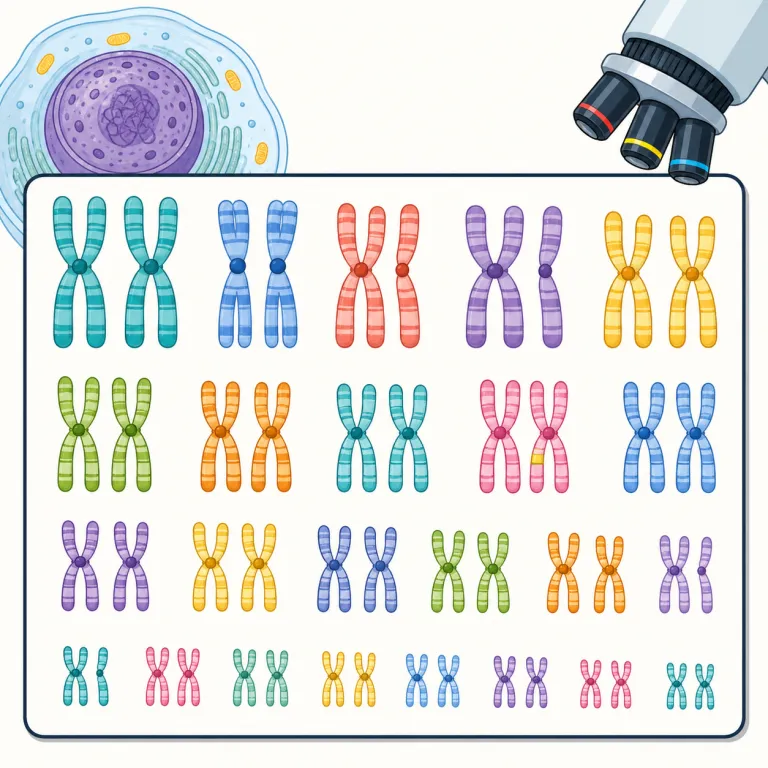
核型
解説 Definition
生物学用語で、ある個体や種における染色体一式の数、大きさ、形などの特徴を指します。染色体を一定の規則で並べた画像や図(核型図、カリオグラム)とは区別され、染色体異常などの遺伝学的分析に用いられます。
A karyotype is the complete set of chromosomes in a cell or person, shown by their number, size, and shape. Scientists use it to study genes and to check for some genetic conditions. The term is mainly used in biology and medicine.
覚え方のコツ Memory Tip
karyo- から「核」を、type から「型」を連想し、染色体の数・大きさ・形などで特徴づけられる「核型」と結び付けると覚えやすい。染色体を一定の順に並べた画像や図は核型を示すもので、karyotypeそのものとは区別される。genotypeが遺伝情報、phenotypeが外に現れた特徴を表すのに対し、karyotypeは「染色体構成の特徴」と押さえると混同しにくい。
The part `karyo-` is the same one you may have seen in `eukaryote` and `prokaryote`, so it can remind you of the cell nucleus. Then `type` suggests a pattern or arrangement. Think of a `karyotype` as an arranged picture of chromosomes, and compare it with `genotype` and `phenotype` so each stays in its own place.
例文
The karyotype of humans contains 46 chromosomes arranged in 23 pairs.
ヒトの核型には、23対をなす46本の染色体が含まれています。
Genetic abnormalities can be detected through karyotype analysis.
遺伝的異常は核型分析を通じて検出できます。
The karyotype is essential for diagnosing chromosomal disorders.
核型は染色体異常を診断するために不可欠です。
karyotype の類義語・関連語
紛らわしい語
karyotype の語源・成り立ち Etymology
ギリシャ語 karyon(核・クルミ)+ typos(型・刻印)が語源。細胞核の中の染色体を型として分類・配列したもの。関連語: eukaryote(真核生物)、prototype(原型)。クルミの殻に包まれた核のイメージが細胞核の命名に使われた。
"Karyotype" comes from Greek karyon, meaning "nut" or later "kernel, nucleus," and typos, meaning "type" or "pattern." In science, karyo- came to refer to the cell nucleus, and "type" described the arranged form or pattern of chromosomes. Related words include eukaryote and prototype.
同じレベルの語彙をもっと
外部辞書で調べる
この英単語をクイズで覚えよう