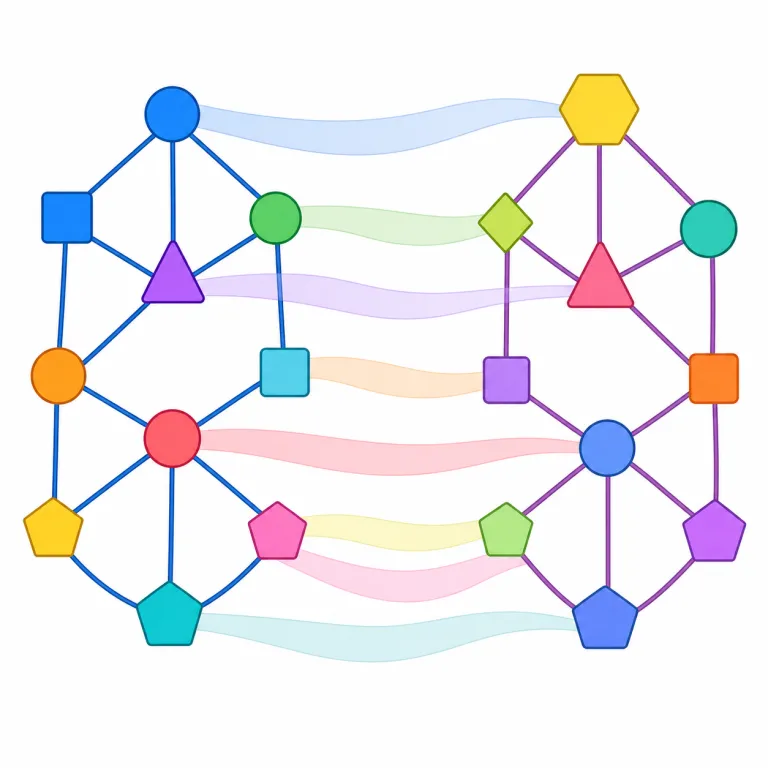
準同型
解説 Definition
群や環など二つの代数的構造の間で、演算の対応関係を保つ写像を指す。ある構造での計算結果が、写像を通してもう一方でも対応する形で保たれるのが特徴で、抽象代数学で構造を比較・分類するための基本概念である。
A homomorphism is a mathematical function that preserves structure when one system is mapped to another. It is used in areas such as algebra, where important relationships stay the same after the mapping. This is a technical term mainly used in higher-level mathematics.
覚え方のコツ Memory Tip
abstract algebraで見る morphism は「構造を保つ写像」の総称。まず map/function の一種だと押さえ、homo- が付いたら same operation を保って送る、と覚えると残りやすい。群なら f(xy)=f(x)f(y)、環でも足し算・掛け算の形を壊さないのが核心。isomorphism はさらに reversible で完全に同型、endomorphism は同じ対象の内側への写像。morphism 系は preserve structure が共通フック。
Learn the family first: a `morphism` is a structure-preserving map in math. Then add `homo-`, which suggests "same," so a `homomorphism` keeps the operation pattern the same when moving from one structure to another. It also helps to compare it with `isomorphism`, which is a stronger, reversible version.
例文
Homomorphism is a fundamental concept in abstract algebra.
準同型は抽象代数学の基本概念である。
The mathematician proved the existence of a homomorphism between the two groups.
その数学者は二つの群の間に準同型が存在することを証明した。
Understanding homomorphisms is essential for ring theory.
環論を学ぶには準同型を理解することが不可欠だ。
homomorphism の類義語・関連語
homomorphism の語源・成り立ち Etymology
ギリシャ語由来の homo-「同じ」+ morphē「形」+ -ism が合わさった近代数学語です。原義は「同じ形を保つこと」で、写しても構造の対応が崩れないので準同型写像と呼ばれます。同根語に morphology, metamorphosis があります。
`Homomorphism` comes from Greek elements: `homo-` meaning same, `morphē` meaning form or shape, and `-ism`. It was formed in modern mathematics to express the idea of preserving form or structure when one thing is mapped to another. The meaning shifted from literal shape to abstract structural similarity. Related words from the same root include `morphology` and `metamorphosis`.
同じレベルの英単語をもっと
外部辞書で調べる
この単語を英単語クイズで覚えよう