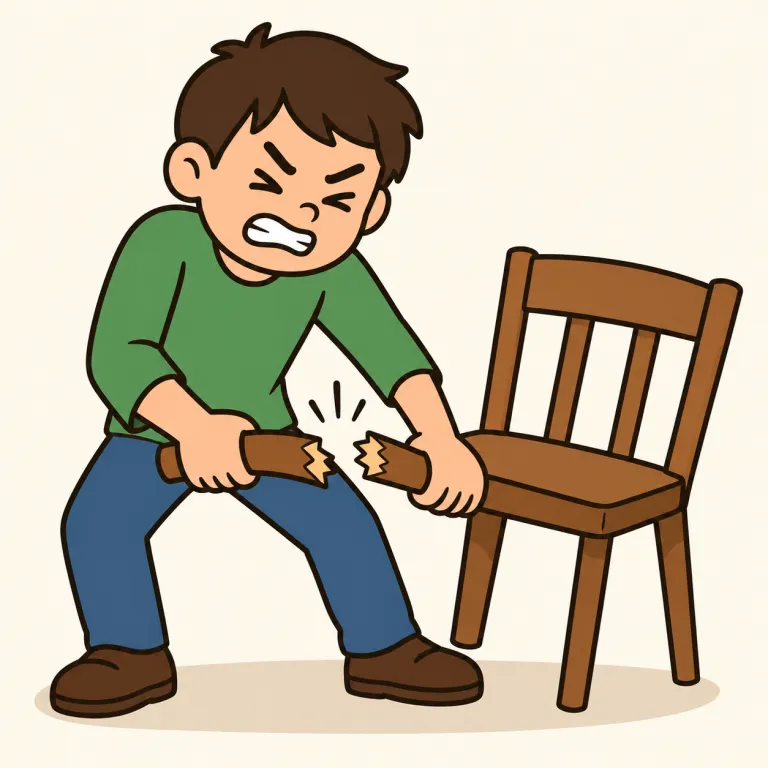
壊す
解説 Definition
breaking は break(壊す、壊れる)の現在分詞・動名詞です。何かを壊している最中の動作や、壊すこと自体を表すときに使います。
Breaking is the present participle or gerund of break. It refers to causing something to separate into pieces, become damaged, or stop working, either as an action in progress or as the name of the action itself.
覚え方のコツ Memory Tip
breaking は break「壊す、壊れる」に -ing を付けた形で、break+ing と綴り、発音は /ˈbreɪkɪŋ/。is breaking the chair なら進行中の動作、Breaking the glass was an accident なら「割ること」を主語にした動名詞になる。物が力で分かれたり機能しなくなったりする場面を核にし、broken という過去分詞とも区別しよう。
Start with the irregular verb break and add -ing regularly: break, breaking. Keep the vowel sound /eɪ/, giving /ˈbreɪkɪŋ/. In “He is breaking the chair,” the form is a present participle in a progressive verb phrase. In “Breaking the glass was an accident,” it is a gerund naming the action. Picture force causing an object to split, become damaged, or stop functioning. This core image covers chairs, toys, and glass. Do not confuse breaking with broken: breaking presents the action, while broken is the past participle and often describes the resulting condition.
例文
He is breaking the old chair.
彼は古い椅子を壊しています。
Stop breaking your toys.
おもちゃを壊すのはやめなさい。
Breaking the glass was an accident.
ガラスを割ったのは事故でした。
breaking の類義語・関連語
breaking の語源・成り立ち Etymology
古英語 brecan(壊す)が語源で、ゲルマン祖語 *brekaną に遡る。ラテン語 frangere(壊す)とも印欧祖語で繋がる。関連語: brake(ブレーキ=動きを断つ)、fragment(破片)。「力を加えて分離する」が核心の意味。
Breaking is the -ing form of break, which comes from Old English brecan, “to break, shatter, or violate.” The word continues a Germanic verb reconstructed as brekaną and has more distant Indo-European relatives associated with breaking, including Latin frangere. Adding -ing creates a present participle or gerund without altering the base spelling. Across its history, the central idea has remained causing continuity, structure, or proper operation to come apart.
同じレベルの語彙をもっと
外部辞書で調べる
この英単語をクイズで覚えよう