ダイポールアンテナ
noun 名詞無線通信で、給電点の両側に伸びる二本の導体からなる基本的なアンテナを指します。電波の送受信に用いる具体的な装置で、電荷や磁極の組を表す抽象的な物理概念とは区別されます。
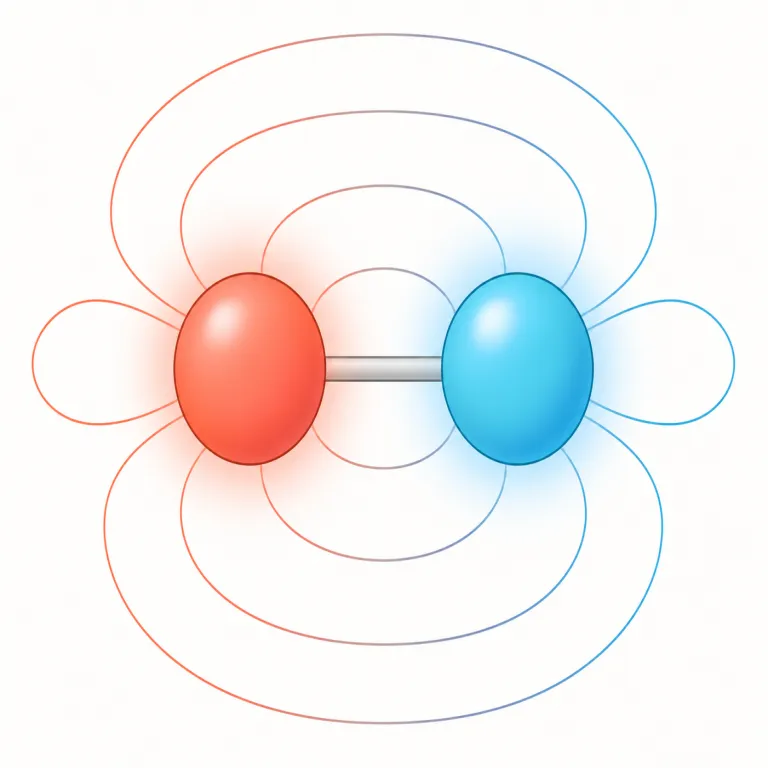
dipole はTOEFL 100・IELTS 7.5レベルの英単語で、「双極子」という意味があります。発音記号は /ˈdaɪˌpoʊl/ です。
双極子(そうきょくし)とは、物理学における2つの等しく反対の電荷または磁気の極を持つシステムです。電気や磁気の場の研究で重要な概念であり、分子の構造にも関連します。
A dipole is something that has two opposite ends or poles, especially in physics. It is commonly used for electrical or magnetic systems with a positive and a negative side, or a north and south pole. The word is mainly technical and appears in science contexts.
di- を見たらまず「2」、pole は north pole / south pole の pole「極」と結びつけると覚えやすいです。dipole は直訳気味に「2つの極をもつもの」。物理では + と -、磁気では N と S が向かい合うセットを指し、electric dipole / magnetic dipole の形で頻出です。pole が極そのもの1点を指すのに対し、dipole は反対の極が対になった全体を指す、と区別すると定着します。bipolar も「2極性」ですが、dipole は特に物理・化学での具体的な対のイメージが強い語です。
Start with `di-`, which means "two." Then connect `pole` with `north pole` and `south pole`, so a `dipole` is something with two poles. This word often appears in `electric dipole` and `magnetic dipole`. Remember: one `pole` is one end, but a `dipole` is the full two-end pair.
A water molecule forms an electric dipole.
水分子は電気双極子を形成します。
The physicist calculated the dipole moment of the compound.
物理学者は化合物の双極子モーメントを計算した。
Dipole interactions affect the behavior of polar molecules.
双極子相互作用は極性分子の挙動に影響します。
文脈によって、次の意味でも使われます。
無線通信で、給電点の両側に伸びる二本の導体からなる基本的なアンテナを指します。電波の送受信に用いる具体的な装置で、電荷や磁極の組を表す抽象的な物理概念とは区別されます。
dipole は19世紀に作られた科学語で、ギリシャ語 di-「二つ」と pole「極」から成ります。pole はギリシャ語 polos「軸・回転の中心」に由来し、そこから電気や磁気の「極」を表すようになりました。つまり「双極子」は二つの極をもつものという語源どおりの語で、関連語は bipolar, monopole です。
Dipole was formed in 19th-century scientific English from Greek di- meaning "two" and pole. Pole goes back to Greek polos, meaning an axis or turning point, and later came to mean an electrical or magnetic end point. So dipole originally meant something with two poles; related words include bipolar and monopole.
この英単語をクイズで覚えよう