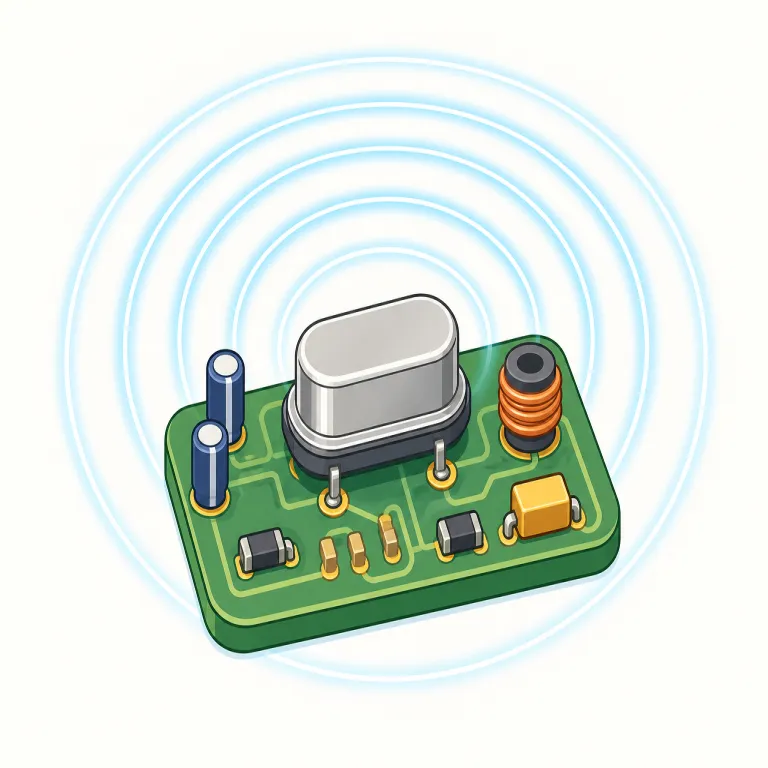
oscillator
oscillator はTOEFL 100・IELTS 7.5レベルの英単語で、「発振器」という意味があります。発音記号は /ˈɑːsəˌleɪtɚ/ です。
発振器
解説 Definition
発振器、電気信号や波動を周期的に発生させる装置。特定の周波数の振動を生成する機械。
An oscillator is a device or system that produces a repeated signal, movement, or pattern. It is commonly used in electronics, physics, and engineering, especially for creating sound waves, radio signals, or timing signals. The word can also refer more generally to something that moves back and forth in a regular way.
覚え方のコツ Memory Tip
oscillate(揺れ動く)や oscillation(振動)を知っていると、oscillator は「揺れを作り出すもの」とまとまって覚えやすいです。-or / -ator は「その働きをする物・装置」によく付くので、calculator や generator と同じ感覚で見られます。意味は単なる発電機ではなく、一定の周期で信号や波を出し続ける装置。電子回路では crystal oscillator, local oscillator の形で頻出で、「周期的に振れる信号源」という像を持つと定着します。
Start from `oscillate` or `oscillation`, then notice `-or` / `-ator`, which often means a thing or machine that does something, like `generator`. So an `oscillator` is a device that produces regular back-and-forth signals. Remember common pairs like `crystal oscillator` and `local oscillator`.
例文
The oscillator generated a steady signal at the required frequency.
その発振器は必要な周波数で安定した信号を生成した。
The electronic oscillator is a critical component in radio transmitters.
その電子発振器はラジオ送信機の重要な部品である。
The oscillator's accuracy is essential for precise timing in the system.
その発振器の精度はシステムの正確なタイミングに不可欠である。
oscillator の類義語・関連語
oscillator の語源・成り立ち Etymology
oscillator はラテン語 oscillare「揺れる」が核で、oscill-「揺れ動く」+ -ator「その働きをするもの」と分けられます。oscillate や oscillation と同根なので、発振器が電気を“往復に揺らして”周期を作る装置だと語源から理解できます。
Oscillator comes from Latin oscillare, meaning "to swing" or "move back and forth." The ending -ator means "something that does or causes," so the word literally means "something that makes a swinging motion." It is closely related to oscillate and oscillation, and the idea later extended to regular repeated movement in science and electronics.
同じレベルの英単語をもっと
TOEFL 100の一覧へ →外部辞書で調べる
この単語を英単語クイズで覚えよう