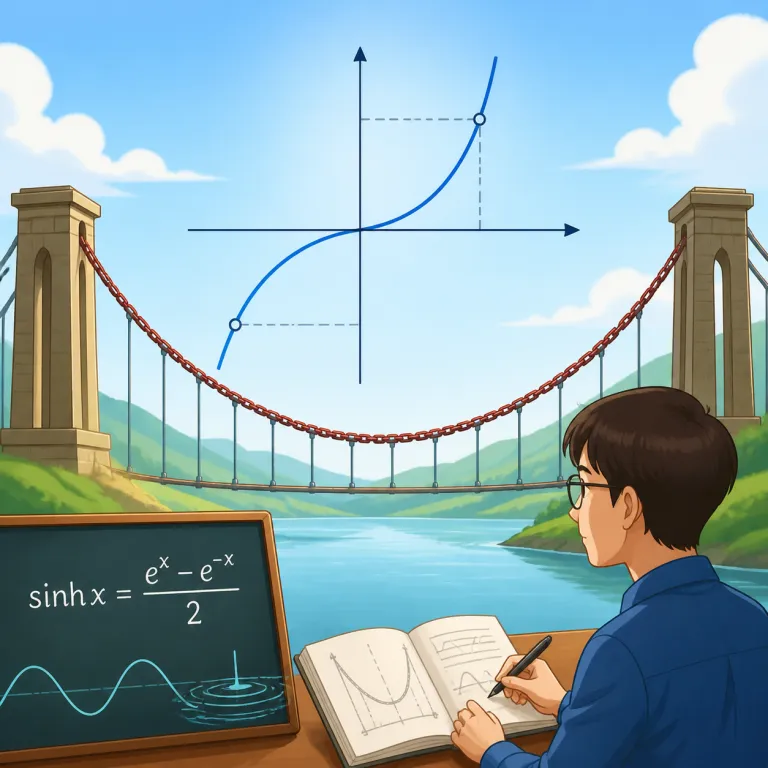
双曲線正弦
解説 Definition
双曲線関数の一つで、指数関数を使って定義される双曲線正弦を表す数学記号。微分方程式、波動解析、懸垂線の計算、物理や工学のモデル化などで用いられ、sin に対応する双曲線版の関数として扱われる。
Sinh is a mathematical term meaning the hyperbolic sine function. It is used in algebra, calculus, physics, and engineering. This is a technical word, usually seen in formulas rather than everyday language.
覚え方のコツ Memory Tip
sin を知っていれば、sinh はまず「sin の仲間」だとつかむと覚えやすいです。ポイントは最後の h で、これは hyperbolic の印。つまり三角関数の sin そのものではなく、「双曲線版の sin」。実際には cosh, tanh と3つ組で出ることが多く、式でも sinh x, cosh x, tanh x の並びで見かけます。sin と見た目がかなり近いので混同しやすいですが、『末尾に h が付いたら双曲線関数ファミリー』とまとめて覚えると、数式中でも判別しやすくなります。
See `sinh` as `sin` with an extra `h`. That `h` is the key memory hook: it stands for the hyperbolic family, like `cosh` and `tanh`. So when you see the final `h`, think: not regular trig, but the hyperbolic version.
例文
Sinh is a hyperbolic function widely used in mathematics and physics.
双曲線正弦は、数学や物理学で広く使われる双曲線関数の一つです。
Engineers use sinh to model catenary curves and cable suspension.
工学では、双曲線正弦を使って懸垂線やケーブルのたるみをモデル化します。
The sinh function appears frequently in differential equations and wave analysis.
双曲線正弦関数は、微分方程式や波動解析にしばしば現れます。
sinh の語源・成り立ち Etymology
sinhはsin(e)+h(yperbolic)を縮めた20世紀の数学略号。sineは中世ラテン語sinus「曲がり」、hyperbolicはギリシャ語hyper-「越えて」+ballein「投げる」由来で、つまり「双曲線版のsine」。関連語はsinusoidal, hyperbola。
Sinh is a 20th-century mathematical short form of sine hyperbolic. Sine came through Medieval Latin from sinus, meaning "curve" or "fold," while hyperbolic comes from Greek parts meaning "to throw beyond." The name was created to mean the hyperbolic version of sine, as in related words like sinusoidal and hyperbola.
同じレベルの語彙をもっと
外部辞書で調べる
この英単語をクイズで覚えよう