ベクトル
解説 Definition
vector は、数学や物理で大きさと向きをもつ量、つまりベクトルという意味です。日本語の「ベクトル」とほぼ同じですが、英語では病気を運ぶ生物などを指す別の意味もあります。
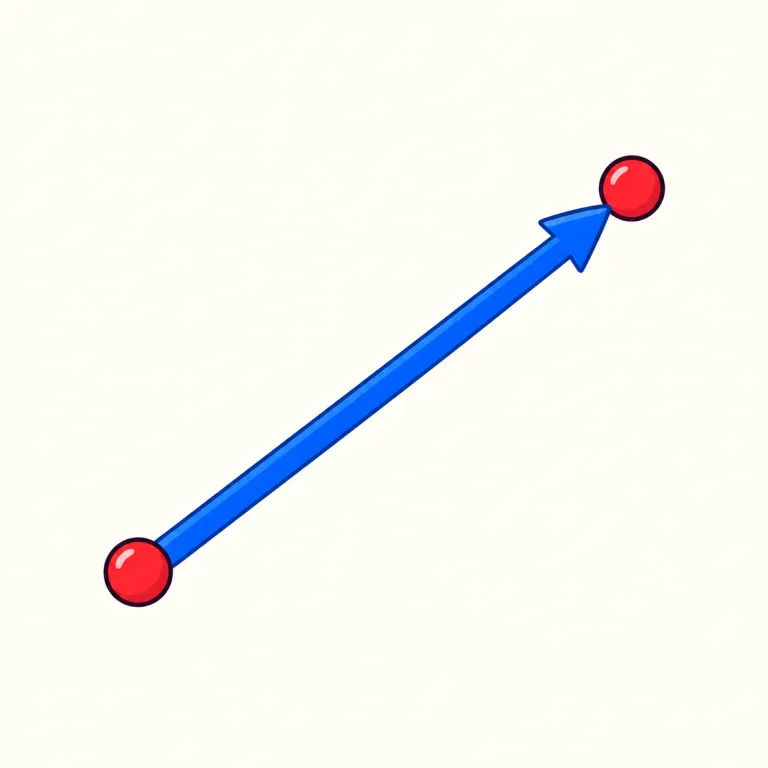
In mathematics and physics, a vector is a quantity represented by both magnitude and direction, often drawn as an arrow whose length indicates size and whose pointed end indicates the direction of action or movement.
覚え方のコツ Memory Tip
数学・物理の vector は「大きさ」と「向き」を一組で表す量。矢印を思い浮かべ、長さが大きさ、矢じりが向きを示すと覚える。ラテン語の「運ぶ者」という核は vehicle ともつながるが、例文では病原体の媒介者ではなく、点Aから点Bへの移動を表す数学的ベクトルに限定する。
Picture a vector as an arrow. Its length tells you the magnitude, while its arrowhead tells you the direction. This makes it different from a scalar, which has magnitude but no direction. For example, speed alone is scalar, but velocity—including a direction—is a vector. Connect the word with the Latin idea of carrying: a vector can be imagined as carrying a point or object from one position toward another. In the given sense, focus on mathematical and physical uses such as drawing a vector from point A to point B or representing an object’s movement.
例文
Draw a vector from point A to point B.
点Aから点Bへ向かうベクトルを描いてください。
The vector shows both speed and direction.
そのベクトルは速さと方向の両方を示しています。
We used a vector to describe the movement of the object.
私たちは物体の動きを表すためにベクトルを使いました。
vector の類義語・関連語
vector の語源・成り立ち Etymology
ラテン語 vector(運ぶ者)から。vehere(運ぶ)の過去分詞 vectus に由来し、「方向を持って運ぶもの」が原義。関連語: vehicle(乗り物)、convey(伝える)。数学では「大きさと方向を持つ量」、IT では「攻撃経路」など、運搬のイメージが多方面に拡張されている。
Vector comes from Latin vector, meaning “carrier” or “one who conveys,” from vehere, “to carry or transport.” Its stem is related to words such as vehicle and convey. The mathematical term was adopted for a quantity that can represent directed movement or displacement, as though it carries something from one point toward another. From this central idea of transmission, vector also acquired other technical senses, but here it specifically denotes a quantity with magnitude and direction.
同じレベルの語彙をもっと
外部辞書で調べる
この英単語をクイズで覚えよう