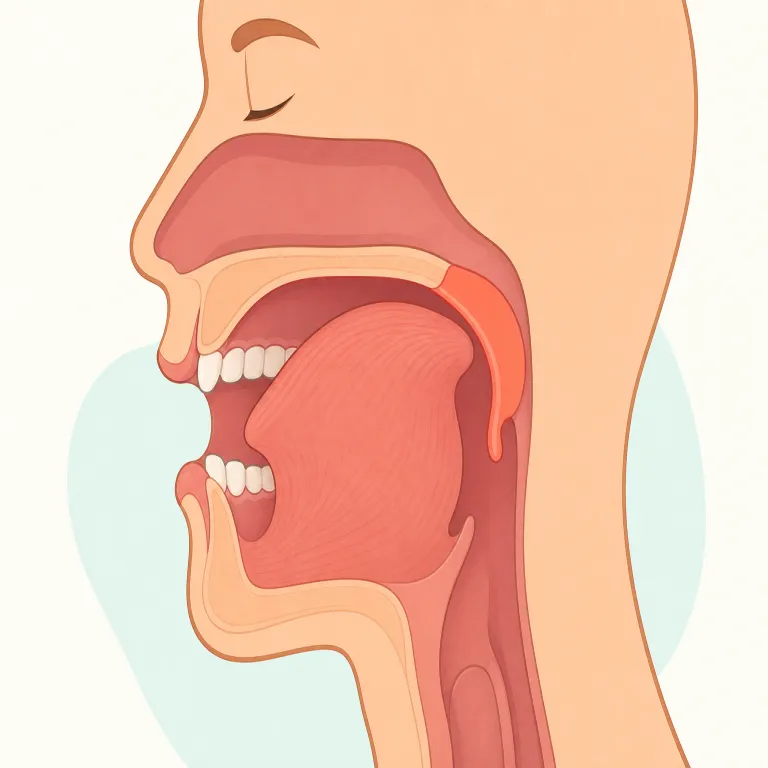
軟口蓋の
解説 Definition
音声学で舌の後部が軟口蓋に接近して発音される子音を指す用語。
Velar means connected with the soft back part of the roof of the mouth, called the velum. In linguistics, it describes speech sounds made with the back of the tongue near that area, such as the sounds in "k" and "g."
覚え方のコツ Memory Tip
音声学の用語として覚えるなら、まず k・g・ng を思い出すと定着しやすいです。これらは舌の後ろが口の奥に当たって出る代表的な velar sound。labial が唇、dental が歯、alveolar が歯ぐき周辺なのに対し、velar は「もっと奥」。発音位置を口の前から後ろへ並べると区別しやすいです。特に palatal と混同しやすいので、palatal は硬口蓋寄り、velar はさらに後ろの軟口蓋寄り、と場所で覚えるのが有効です。
Remember it with the sounds `k`, `g`, and `ng`, which are classic `velar` sounds. In pronunciation terms, `velar` means the back of the tongue goes to the back part of the mouth. To avoid confusion, think: `palatal` is a bit more forward, `velar` is further back.
例文
The sounds /k/ and /g/ are classified as velar consonants in phonetics.
/k/と/g/の音は音声学では軟口蓋子音に分類される。
The linguist studied the velar fricatives found in Scottish Gaelic.
その言語学者はスコットランド・ゲール語に見られる軟口蓋摩擦音を研究した。
Velar sounds are produced by the back of the tongue touching the soft palate.
軟口蓋音は舌の後部が軟口蓋に触れることで発音される。
velar の類義語・関連語
紛らわしい語
velar の語源・成り立ち Etymology
velar は新ラテン語・ラテン語 velum「覆い、帆、幕」から来た語で、-ar は「〜に関する」を表します。解剖学で軟口蓋を velum と呼んだため「軟口蓋の」の意味になり、veil や velum を知ると“覆いのような部分”と納得できます。
Velar comes from New Latin velaris, based on Latin velum, meaning "covering," "curtain," or "sail." In anatomy, velum was used for the soft palate, seen as a kind of covering. From there, velar came to mean "related to the soft palate." It is related to veil, which comes from the same Latin source.
同じレベルの語彙をもっと
外部辞書で調べる
この英単語をクイズで覚えよう