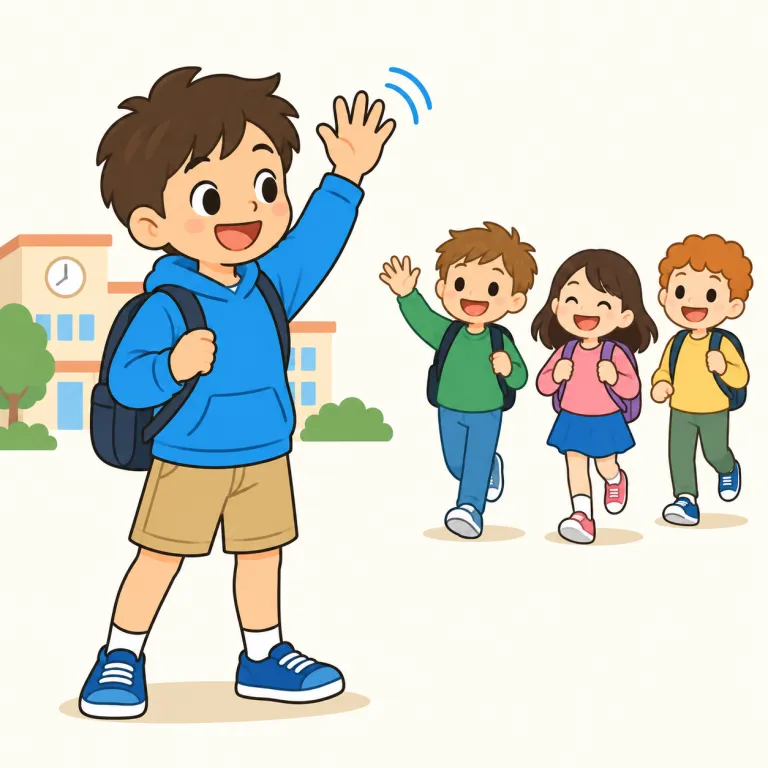
手を振っている
解説 Definition
waving は wave(手を振る、揺れる)の現在分詞・動名詞です。人があいさつや合図として手を振っている様子を表すときによく使います。
Waving is the present participle or gerund of wave. In this sense, it describes moving a hand repeatedly from side to side as a greeting, farewell, or signal to attract someone’s attention.
覚え方のコツ Memory Tip
wave「手を振る」に -ing を付ける際、語末の黙字 e を落として waving とします。is waving at us の wave at 人(人に手を振る)を基本形として覚えましょう。from the bus は手を振る場所、as the train left はその場面を補います。hand を左右に往復させる動きが、水面の wave「波」と共通するイメージです。発音は /ˈweɪvɪŋ/ です。
Begin with wave and drop its final silent e before adding -ing: wave becomes waving, pronounced /ˈweɪvɪŋ/. Link the hand movement to a wave on water: both involve a repeated rising, falling, or side-to-side motion. For greeting or signaling, the most useful pattern is wave at someone, as in The boy is waving at us. Phrases such as waving from the bus identify the person’s location. Do not confuse wave at someone, a friendly or attention-getting gesture, with wave something, which means move an object through the air.
例文
The boy is waving at us.
その男の子が私たちに手を振っています。
I saw her waving from the bus.
彼女がバスから手を振っているのが見えました。
People were waving as the train left the station.
列車が駅を出るとき、人々は手を振っていました。
waving の語源・成り立ち Etymology
waving は wave の現在分詞で、wave は古英語 wafian「揺れる・振る」にさかのぼり、さらにゲルマン祖語の「揺れ動く」語に由来します。手を振る意味は「物を往復に動かす」感覚から自然に生まれたもので、同根語に waver があります。
Waving is the present-participle and gerund form of wave. The verb wave is related to Old English wafian, “to move about or fluctuate,” and to other Germanic words expressing unsteady or repeated movement. Its meaning “move the hand in greeting or as a signal” developed naturally from the broader action of moving something back and forth. Waver belongs to the same historical movement-related word group.
同じレベルの語彙をもっと
外部辞書で調べる
この英単語をクイズで覚えよう