している
解説 Definition
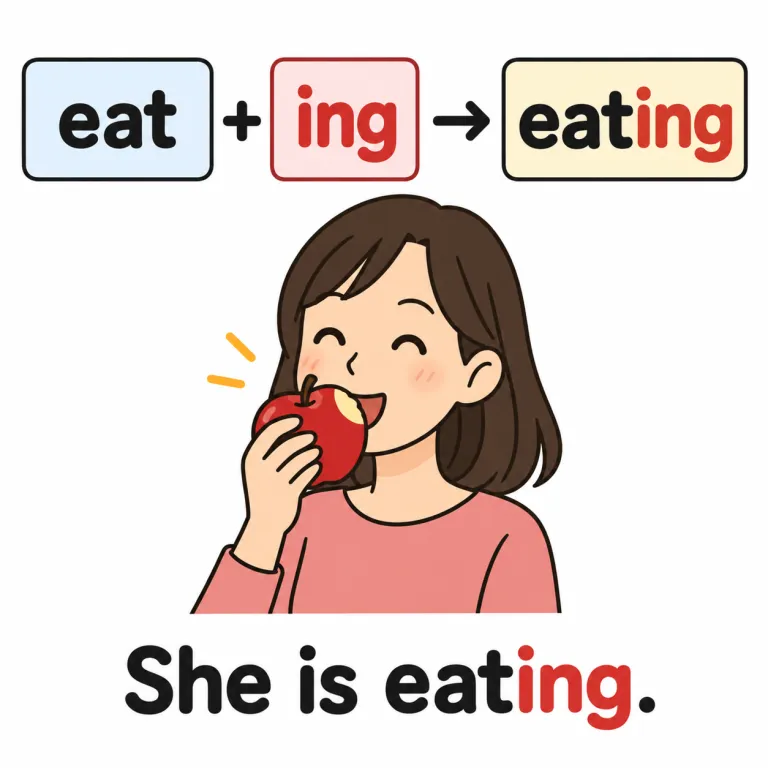
-ing は動詞に付いて現在分詞や動名詞を作る語尾です。できた形は、進行中の動作を表したり、名詞を修飾したり、「すること」として名詞の役割を果たしたりします。
-ing is an English suffix added to verbs to form present participles and gerunds. These forms can help express an action in progress, modify a noun, or allow an action to function as a noun.
使い方 Usage
- be動詞+動詞の-ing形で進行形を作ります。She is running. は「彼女は走っています」です。 Use be plus a verb's -ing form to make a progressive construction: She is running.
- Swimming is fun. の Swimming は「泳ぐこと」という動名詞です。running water では running が名詞を修飾します。 In Swimming is fun, Swimming is a gerund meaning the activity of swimming. In running water, running modifies the noun.
- eat → eating、make → making、run → running のように、原形と-ing形を組にして綴りを覚えましょう。 Learn each base verb with its -ing form: eat → eating, make → making, and run → running.
覚え方のコツ Memory Tip
eating や running の末尾にある -ing を思い浮かべましょう。独立した単語ではなく、動詞に付いて文の中での役割を広げる語尾として覚えます。
Picture the ending -ing in eating or running. Remember it as a suffix attached to a verb, rather than an independent word, that lets the resulting form serve different roles in a sentence.
例文
She is running.
彼女は走っています。
Swimming is fun.
泳ぐことは楽しいです。
The word playing ends in -ing.
playing という語は -ing で終わります。
ing の類義語・関連語
派生語
紛らわしい語
ing の語源・成り立ち Etymology
英語の -ing は古英語の -ing / -ung に由来する語尾で、動作や進行中の状態を名詞化・形容詞化しました。be + 動詞-ing で「今まさにしている」の形になり、doing や running のように動きの最中を表します。
Modern -ing reflects the historical convergence of two English formations. Old English used endings including -ing and -ung to make nouns denoting actions, while present-participial forms originally had a different ending, commonly represented as -ende. Over time, their forms merged in Middle English, leaving -ing for both gerunds and present participles. This history helps explain why the same modern spelling can perform nominal, adjectival, and progressive grammatical functions.
同じレベルの語彙をもっと
外部辞書で調べる
この英単語をクイズで覚えよう