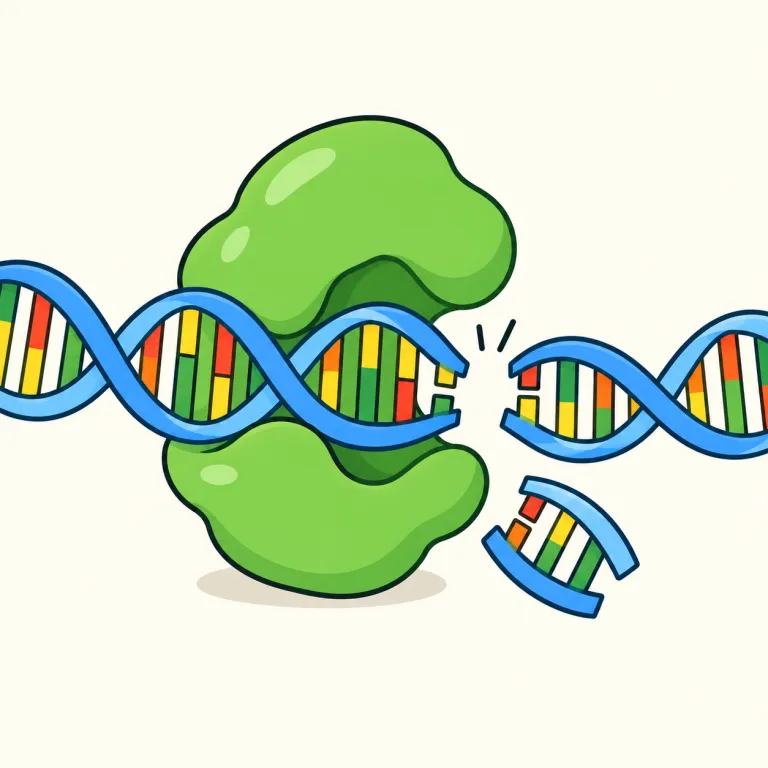
ヌクレアーゼ
解説 Definition
生化学において、核酸(DNAまたはRNA)を分解する酵素。分子生物学研究や遺伝子工学で広く利用される。
A nuclease is an enzyme that cuts or breaks down DNA or RNA. It plays an important role in many biological processes and scientific research. This is a technical word used in biology, genetics, and chemistry.
覚え方のコツ Memory Tip
まず語尾の -ase を見たら「酵素」と反応できるようにする。protease, amylase などと同じ型。前半の nucle- は nuclear や nucleic acid を連想すると「核・核酸」に結びつくので、nuclease で「核酸に作用する酵素」と取れる。実際は DNase / RNase のように DNA や RNA を切る文脈で出やすいので、「DNAを分解する酵素」という使用場面ごと覚えると定着しやすい。nucleotide のような“部品名”ではなく、“分解する働き手”だと区別すると混同しにくい。
The ending `-ase` is a strong clue: it usually means an enzyme, like in `amylase` or `protease`. The first part, `nucle-`, can remind you of `nucleus` and `nucleic acid`. So `nuclease` is easy to store as an enzyme word connected with DNA or RNA, especially next to forms like `DNase` and `RNase`.
例文
The nuclease enzyme was essential for cleaving the DNA molecule at specific sites.
ヌクレアーゼは、DNA分子を特定の部位で切断するために不可欠だった。
Researchers used a restriction endonuclease to analyze the genetic sequence of the sample.
研究者はサンプルの遺伝子配列を分析するために制限エンドヌクレアーゼを使用した。
Nuclease activity in the cell is carefully regulated to prevent unwanted DNA damage.
細胞内のヌクレアーゼ活性は不要なDNA損傷を防ぐために慎重に調節される。
nuclease の語源・成り立ち Etymology
nuclease は nucleus「核」+ -ase「酵素」から成る科学語で、nucleus はラテン語 nucleus「木の実の核」に由来します。もとは「中心の核」の意なので、「核酸を切る酵素」という意味がつかみやすい語です。関連語は nuclear, endonuclease。
Nuclease is a modern scientific word built from nucleus and the enzyme ending -ase. Nucleus comes from Latin nucleus, originally meaning the kernel or inner part of a nut. The sense moved from a physical "core" to the central part of a cell, and then to enzymes that act on nucleic acids; compare nuclear and endonuclease.
同じレベルの語彙をもっと
外部辞書で調べる
この英単語をクイズで覚えよう