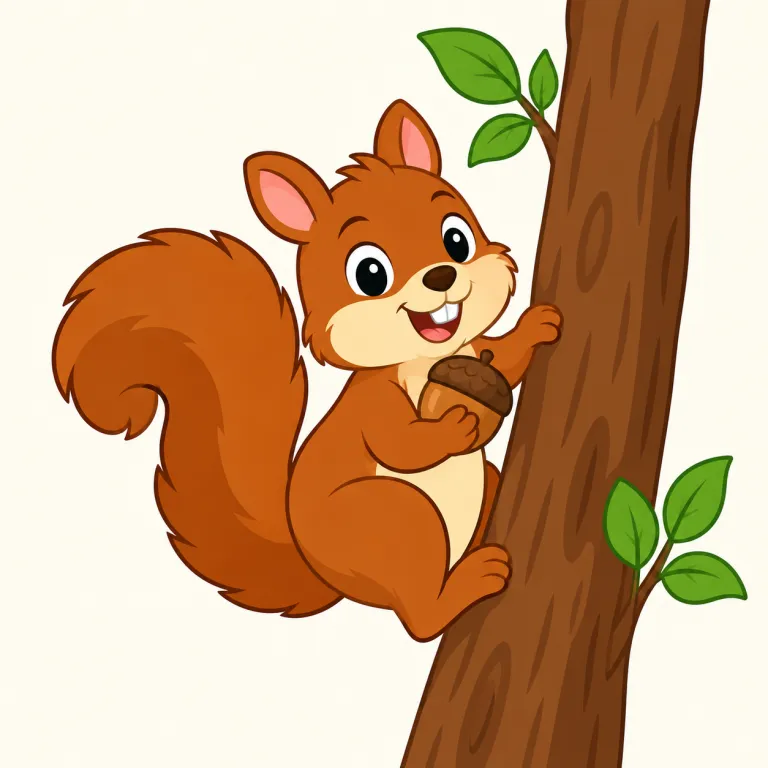
リス
解説 Definition
squirrel は、木に登ったり木の実を食べたりする小動物のリスという意味です。日本語の「リス」に当たりますが、英語の squirrel は発音が日本語とかなり違うので注意が必要です。
A squirrel is a small rodent, usually with a long bushy tail, that commonly climbs trees and eats nuts and seeds. Some species live mainly on the ground or can glide between trees.
覚え方のコツ Memory Tip
squirrel は木に登り木の実を食べる「リス」。発音 /ˈskwɪrəl/ は綴りから想像しにくいので、最初を square に近い /skwɪr/、後半を弱い /əl/ と分けます。a squirrel in a tree、eat nuts、bushy tail の三つを典型場面としてまとめ、chipmunk「シマリス」との範囲の違いにも注意しましょう。
Link squirrel with three visible features: a small rodent, a bushy tail, and nuts near a tree. Useful phrases are a squirrel in the park, a squirrel ran up the tree, and a squirrel eating a nut. The pronunciation /ˈskwɪrəl/ is more compact than the spelling suggests. Practice it in two parts, /skwɪr/ plus a weak /əl/, without trying to pronounce every written vowel separately. A chipmunk is a particular striped member of the squirrel family, so the words overlap biologically, but squirrel is the broader everyday term.
例文
A squirrel ran up the tree.
リスが木を駆け上がりました。
We saw a squirrel in the park.
私たちは公園でリスを見ました。
The squirrel ate a nut near the bench.
そのリスはベンチの近くで木の実を食べました。
squirrel の類義語・関連語
紛らわしい語
squirrel の語源・成り立ち Etymology
ギリシャ語 skiouros(影の尾)が語源で、skia(影)+ oura(尾)の合成語。大きなふさふさの尾を日よけのように使う姿から名付けられた。フランス語 escurel を経て英語に入った。同根の skia は parasol の語根とも関連し、「影・日陰」の概念を共有する。
Squirrel came into English through Middle English and Anglo-French forms such as esquirel, ultimately from Greek skiouros through Latin sciurus. The Greek word is traditionally analyzed as skia, “shadow,” plus oura, “tail,” giving the image of a “shadow-tail.” This description is associated with the animal’s large tail, which can arch over its body. Changes through French help explain why the modern English spelling and pronunciation are not closely matched.
同じレベルの語彙をもっと
外部辞書で調べる
この英単語をクイズで覚えよう