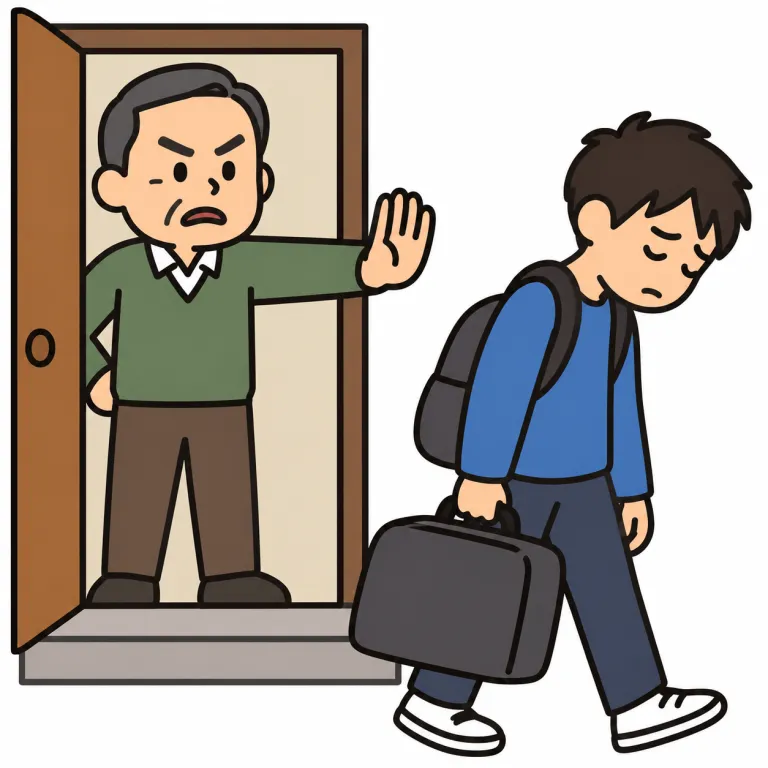
勘当する
解説 Definition
勘当する、関係を切る。法的に子孫を否認する。
Third-person singular present form of disown, meaning to formally reject a family relationship or refuse to acknowledge someone as one's relative. It can also mean to deny ownership of, responsibility for, or connection with something.
覚え方のコツ Memory Tip
原形 disown に、三人称単数現在を示す -s が付いた形。語尾の own が有声音 /n/ で終わるため、-s は /z/ と発音する。「親族との関係を断つ」だけでなく、disown responsibility のように責任・関与を「自分のものではない」と否認する場面も一緒に覚える。
Connect disowns directly to the base verb disown: dis- suggests separation or negation, while own means to possess or acknowledge as one's own. The final -s marks the third-person singular present, as in “the father disowns,” and it is pronounced /z/ because own ends in the voiced sound /n/. Remember both common patterns: a person disowns a relative by rejecting the relationship, and someone disowns responsibility by denying any connection with it.
例文
The father disowns his son for refusing the family business.
父は家族事業を拒否したために息子を勘当しました。
He disowns all responsibility for the accident.
彼は事故のすべての責任を勘当しています。
The character disowns her own child in the dramatic climax.
キャラクターは劇的なクライマックスで彼女の子供を勘当しました。
disowns の類義語・関連語
disowns の語源・成り立ち Etymology
dis-(否定・分離、ラテン語dis-)+ own(古英語āgen「自分のもの」)。「自分のものではないとする」→「勘当する、関係を断つ」。関連語: own, owner。所有の否定が縁切りの意味に発展した。
Disowns is the third-person singular present form of disown. The verb combines the prefix dis-, expressing reversal, negation, or separation, with own, which developed from Old English āgen, meaning “one's own.” The literal idea of treating someone or something as “not one's own” developed into the senses of rejecting a relative and denying responsibility, ownership, or association.
同じレベルの語彙をもっと
外部辞書で調べる
この英単語をクイズで覚えよう