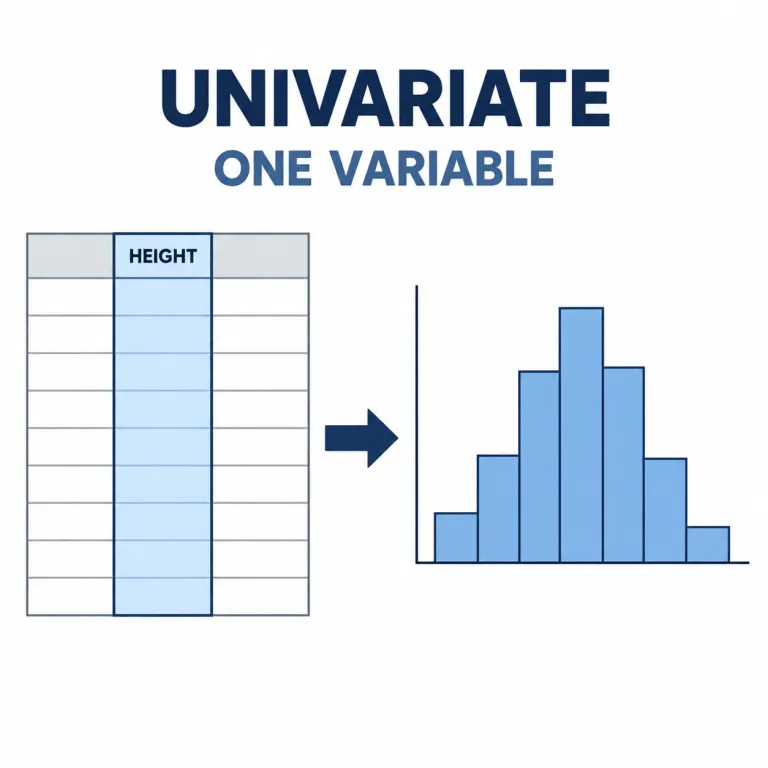
単変量
解説 Definition
統計学における単一の変数のみに関するもの。二つ以上の変数の関係を扱わない分析方法。
Univariate describes something that involves only one variable. It is mainly used in mathematics, statistics, and data analysis when studying or describing one factor by itself. This word is technical and usually appears in academic or professional writing.
覚え方のコツ Memory Tip
uni- は uniform, unicorn, unilateral などで見慣れた「1つ」の感覚、-vari- は variable の「変わる量=変数」を思い出すと、univariate は形だけで「変数が1個の」と読めます。統計では bivariate, multivariate とセットで覚えるのが効率的で、univariate analysis は平均・中央値・分散・ヒストグラムのように、まず1変数だけの分布を点検する段階。相関や回帰のように変数どうしの関係を見る語ではない、と対比で固定すると忘れにくいです。
`Uni-` means one, as in `uniform` or `unilateral`, and `vari-` links to `variable`. So `univariate` is easy to read as “having one variable.” It sticks better if you learn it beside `bivariate` and `multivariate`.
例文
The study used univariate analysis to examine each variable independently.
その研究は各変数を独立して検討するために単変量分析を使用した。
Univariate statistical tests are simpler than multivariate ones.
単変量の統計検定は多変量検定より単純である。
The researcher conducted a univariate analysis of income distribution.
研究者は所得分布の単変量分析を実施した。
univariate の類義語・関連語
univariate の語源・成り立ち Etymology
univariate はラテン語 unus「1つ」の uni- と variate から成る語です。variate は varius「変化する」に通じ、variable や variety と同根なので、「変数が一つだけの」という統計の意味が語の形にそのまま表れています。
Univariate comes from uni-, from Latin unus meaning "one," and variate, from the same root as variable and variety. That root goes back to Latin varius, meaning "changing" or "different." The form shows the history clearly: it describes something with only one variable.
同じレベルの語彙をもっと
外部辞書で調べる
この英単語をクイズで覚えよう