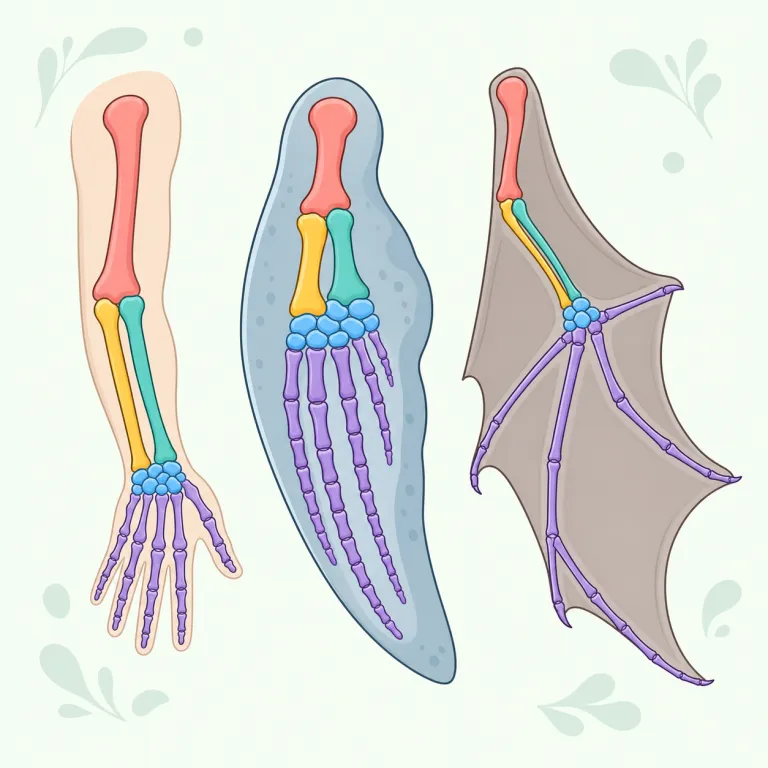
ホモロジー
noun 名詞代数的位相幾何学で、空間に存在する穴や連結の仕方を、群などの代数的構造によって表す概念です。homology group のように使われ、生物の共通祖先に基づく相同性とは異なる数学用語です。
相同性は、異なる種や構造における類似性、特に進化的起源に関連する構造的同等性を指します。生物学で頻繁に使用される概念です。
Homology is a similarity between structures, genes, or features because they come from a common origin. It is mainly used in biology, genetics, and anatomy. The word refers to shared basic relationships, even if the present forms or functions are different.
まず homologous と対で覚えると残りやすい語です。biology で homology は『ただ似ていること』ではなく、『進化的な起源が同じで、対応関係があること』を指します。翼・腕・ひれのように形や働きが違っても、元の設計図が共通なら homology。よく混同する analogy は『機能は似るが由来は別』なので、homology は similarity より origin 重視、と整理すると定着しやすいです。
Learn it together with `homologous`. In biology, this word is about shared origin, not just things looking similar. It becomes easier to remember if you contrast it with `analogy`: `homology` focuses on the same source, while `analogy` focuses more on similar function.
The homology between human arms and bat wings suggests a common evolutionary ancestor.
人間の腕とコウモリの翼の相同性は共通の進化的祖先を示唆しています。
Scientists study homology to understand the evolutionary relationships between different species.
科学者は異なる種の進化的関係を理解するために相同性を研究しています。
The homology of bone structures across mammals provides evidence for evolution.
哺乳動物全体に見られる骨構造の相同性は、進化の証拠となります。
文脈によって、次の意味でも使われます。
代数的位相幾何学で、空間に存在する穴や連結の仕方を、群などの代数的構造によって表す概念です。homology group のように使われ、生物の共通祖先に基づく相同性とは異なる数学用語です。
homology はギリシャ語 homo-「同じ」+ -logy のもとになる logos「関係・説明」に由来します。homologous や logic と同じ要素を含み、「別々でも対応関係が同じ」という感覚で捉えると、生物や数学の相同性が理解しやすくなります。
Homology comes from Greek homo-, meaning "same," together with a form related to logos, meaning "relation," "account," or "reason." It shares parts with words like homologous and logic. The core idea is not simple sameness, but a matching or corresponding relation that was later used in fields like biology and mathematics.
この英単語をクイズで覚えよう