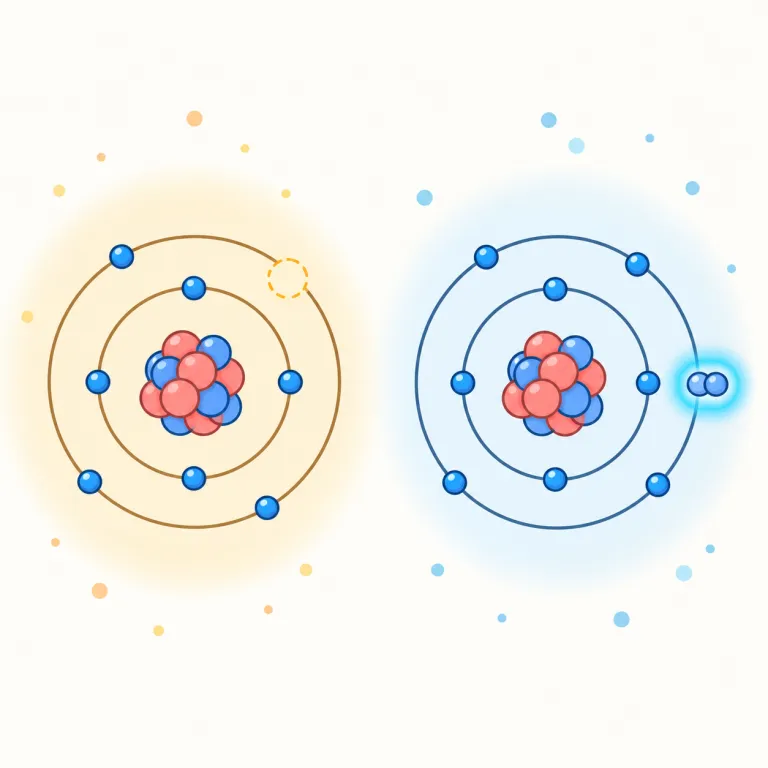
イオン
解説 Definition
正の電荷または負の電荷を持つ、原子や分子から電子が加わったり失われたりした粒子のこと。化学反応で重要な役割を果たす。
An ion is an atom or group of atoms that has an electric charge because it has gained or lost electrons. Ions are important in chemistry, physics, and biology. This is a technical science word, often used when talking about reactions, electricity, or minerals in the body.
覚え方のコツ Memory Tip
ion は単独で丸暗記するより、atom→electron→ion の流れで整理すると残りやすい。原子 atom は基本中性だが、電子 electron を失ったり受け取ったりすると、電気を帯びた粒子 ion になる。つまり atom と対比して「中性なら atom、電荷ありなら ion」で区別する。さらに cation / anion の共通パーツでもあるので、「イオン=電荷をもつ粒子の総称」を先に固定すると派生語も覚えやすい。positive ion, negative ion, ions in solution のような化学の定番場面と一緒に結びつけると定着しやすい。
Remember it through contrast: an `atom` is neutral, but an `ion` has electric charge. So the key memory hook is simple: charge = ion. This also helps with related words like `cation` and `anion`.
例文
An ion can be positive or negative.
イオンには正のものと負のものがある。
Positive ions and negative ions attract each other.
正のイオンと負のイオンは互いに引きつけ合う。
Salt solution contains sodium ions and chloride ions.
塩水にはナトリウムイオンと塩化物イオンが含まれている。
ion の類義語・関連語
ion の語源・成り立ち Etymology
ギリシャ語 ion(行くもの)から。動詞 ienai(行く)の現在分詞形で、電場中を移動する粒子をファラデーが1834年に命名。電極に向かって「行く」性質に着目した命名。関連語:anion(上に行く=陰イオン)、cation(下に行く=陽イオン)。
Ion comes from Greek ion, meaning "going," from the verb ienai, "to go." The scientist Michael Faraday introduced the term in 1834 for a charged particle that moves toward an electrode. The name reflects the idea of movement in an electric field. Words like anion and cation were built from the same base.
同じレベルの語彙をもっと
外部辞書で調べる
この英単語をクイズで覚えよう